-
Opening day
-
Submission deadline
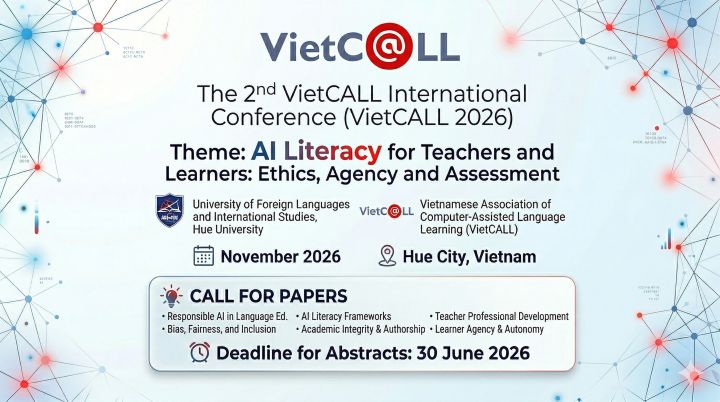
📢 Call for Abstracts
The 2nd VietCALL International Conference 2026
🗓 Conference Dates: 26–27 November 2026
📍 Location: Hue City, Vietnam
🌐 Timezone: Asia/Ho_Chi_Minh
🏛 Organizer: Vietnamese Association of Computer-Assisted Language Learning (VietCALL)
✨ Conference Theme
AI Literacy for Teachers and Learners: Ethics, Agency and Assessment
The VietCALL International Conference 2026 invites scholars, educators, researchers, policymakers, and graduate students to explore how Artificial Intelligence (AI) is transforming language education.
As AI becomes deeply embedded in teaching, learning, and assessment, the field faces urgent questions:
- How can AI be used responsibly and ethically?
- How can teachers and learners develop AI literacy beyond tool usage?
- How can assessment remain valid, fair, and meaningful in AI-supported environments?
This conference provides a platform to critically examine these issues while promoting evidence-based, pedagogically grounded, and socially responsible practices in Computer-Assisted Language Learning (CALL).
💡 Conference Strands / Topics
Submissions are invited in (but not limited to) the following areas:
1️⃣ Ethics & Responsible AI in Language Education
- Ethical frameworks for AI use in language teaching and learning
- Bias, fairness, and inclusion in AI systems
- Academic integrity and authorship in AI-assisted work
- Data privacy and responsible data practices
2️⃣ AI Literacy, Agency & Assessment
- AI literacy frameworks for teachers and learners
- Integrating AI literacy into language curricula
- AI-aware assessment design and validation
- Learner autonomy and self-regulated learning with AI
3️⃣ Teacher Development & Institutional Transformation
- Professional development for AI-integrated teaching
- Teacher beliefs, identity, and agency in AI contexts
- Institutional policies and governance for AI use
- Implementing AI competency frameworks in education
4️⃣ AI-Supported Language Teaching & Learning
- AI tools for feedback, writing, speaking, and interaction
- Human–AI collaboration in language classrooms
- Task-based and communicative approaches with AI
- Blended and online learning with AI integration
5️⃣ Research Methods & Evaluation in AI-Enhanced Education
- Mixed-methods and experimental designs
- Learning analytics and AI-based data interpretation
- Measuring AI literacy and learning outcomes
- Validation of AI-supported assessment tools
6️⃣ Linguistics, Culture & Society in the Age of AI
- AI and linguistic theory (semantics, discourse, pragmatics)
- Multilingualism and AI-mediated communication
- Language, identity, and culture in AI environments
- Social impact of AI on language use and communication
📑 Submission Categories
| Type of Submission | Length |
|---|---|
| Full Research Papers | 4,000–6,000 words |
| Short Papers / Work-in-Progress | 2,000–3,500 words |
| Workshops / Demonstrations | 800–1,000 words proposal |
| Poster Presentations | 300–500-word abstract |
📝 Submission Instructions
- Abstracts must be written in English (200–300 words).
- Submissions should clearly state: purpose, methodology, findings (or expected outcomes), and implications.
- Full papers must follow APA 7th Edition.
- File format: .docx
- All submissions will undergo double-blind peer review.
📘 Accepted papers will be considered for publication in:
- Conference Proceedings (ISBN, online PDF)
- Selected journals (subject to review and editorial decision)
📆 Important Dates
- ✅ Abstract Submission Deadline: 30 June 2026
- ✉️ Notification of Acceptance: 15 July 2026
- 📄 Full Paper Submission Deadline: 30 August 2026
- 🗓 Conference Dates: 26–27 November 2026
- 📘 Proceedings Publication: December 2026
🙌 Who Should Submit?
- Language teachers and teacher educators
- Researchers in CALL, Applied Linguistics, and AI in Education
- Graduate students and early-career researchers
- Educational leaders and policymakers
- EdTech developers and AI practitioners
🚀 Join VietCALL 2026
VietCALL 2026 invites the global language education community to move beyond “using AI tools” toward developing critical, ethical, and pedagogically sound AI practices.
👉 Submit your abstract and be part of shaping the future of AI in language education!